.
.





Starting an LLC in Alabama takes a little more legwork than it does in other states. Before you can officially form your business, you’ll need to reserve your LLC name with the Alabama Secretary of State. From there, you’ll appoint a registered agent, file your certificate of formation, and take care of a few other requirements before you can start doing business.
Here’s what you need to know to file your documents correctly, the costs you can expect to pay, and the information you need to have on hand.
Key takeaways
- Alabama requires you reserve your LLC name with the Secretary of State before you file your certificate of formation.
- You create your Alabama LLC by filing a certificate of formation, not "articles of organization," with the Business Entities Division.
- Alabama charges $25 for a mailed name reservation or $28 online. The total formation cost can vary by filing path, processing speed, and any applicable county fees.
- Some Alabama LLCs need a business privilege license depending on the business activity. When one is required, it generally must be obtained in each county where the business is conducted, subject to applicable rules and exceptions.
Step 1: Choose and reserve your Alabama LLC name
You can't file your certificate of formation without an approved certificate of name reservation. Skip this step, and your formation paperwork bounces right back. You’ll file both of these documents with the Secretary of State.
What is a certificate of name reservation?
The certificate of name reservation lets you reserve the rights to use your preferred business name while you finish building out your LLC. Once approved, the state holds it for one year from acceptance, or until you file a written withdrawal, whichever hits first. You can renew for another year, but only within the 90-day window before it expires.
How do you check name availability?
Before filing, search Alabama business name availability through the Secretary of State's Business Entity Records database. Names have to be distinguishable from what's already on file, entity designations aside. Leave "LLC" out of your search terms so you catch close variations under other entity types too. You can search through the SOS website, but LegalZoom’s Alabama business name search tool lets you search the same database quickly and easily.
What naming rules does Alabama have?
Under Alabama Code § 10A-5A-1.08, your name has to contain "Limited Liability Company," "L.L.C.," or "LLC," and it needs to be distinguishable from other entities on file. Words tied to regulated industries like "bank," "trust," "insurance," or "engineer" require extra documentation or regulatory sign-off. Your name can't suggest government affiliation or mislead people about what the business does.
If you want to use a name that’s different from the legal one, register a trade name. This trade name, sometimes called a “doing business as” or “DBA,” allows you to operate your business under a different name than you registered your LLC under.
How can I file my name reservation?
You can reserve your name online through the Secretary of State's Business Services portal for a $28 fee and receive the name-reservation certificate immediately. Otherwise, if you file by mail, it's $25, but there's no guaranteed turnaround timeline. Mail the Name Reservation Request form with a check payable to the Alabama Secretary of State to:
Office of the Secretary of State, Business Services Division, P.O. Box 5616, Montgomery, AL 36103-5616
Free Alabama Business Name Check
Use our free name check tool to search the Alabama Secretary of State database and see if your business name is available.
By clicking "Check Availability," I agree to LegalZoom's Terms of Use. This search is a preliminary check of state databases and does not include variations or trademarks. Results do not guarantee name availability or compliance with legal requirements.
Privacy note: The name and address on your reservation request become part of the public record once your LLC is on file.
Alabama's online system won't let you file the name reservation and certificate of formation together. They're separate filings, and you need the approved reservation in hand before the system accepts your formation filing.
Step 2: Appoint an Alabama registered agent
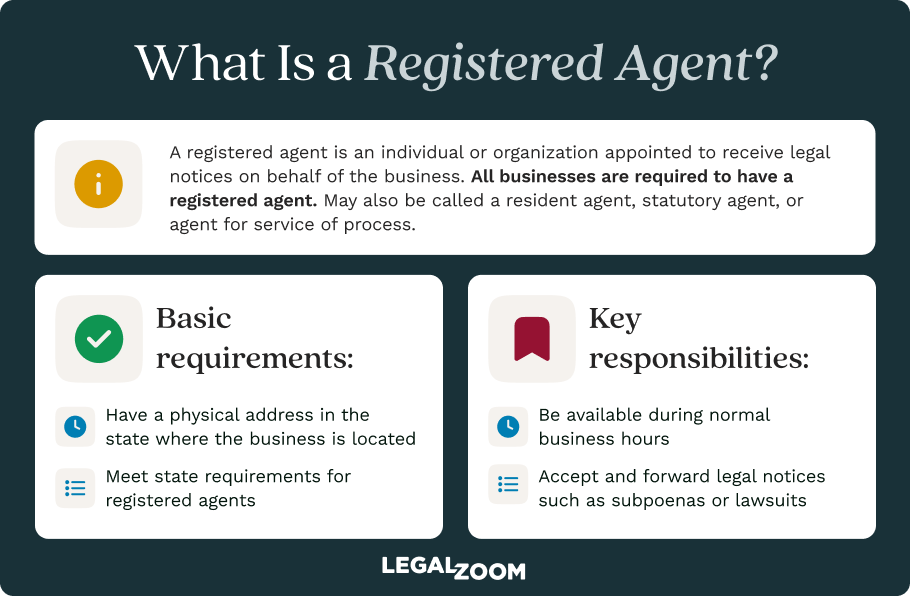
Once your name reservation clears, pick a registered agent, someone (or some company) that receives legal notices and official state mail on your LLC's behalf. This agent goes on your certificate of formation.
Every domestic LLC has to maintain a registered agent with a physical street address in Alabama. Your agent receives service of process and other official notices on the LLC's behalf. Failing to maintain the required registered agent can put the LLC out of compliance and may lead to administrative consequences.
Can you be your own agent?
You can serve as your own registered agent if you meet Alabama's requirements for an individual registered agent, including being an Alabama resident and having a physical street address in the state. A P.O. box does not satisfy the requirement. A commercial registered agent service can be useful when you do not want to use your home address or cannot reliably be available to receive service of process.
Step 3: File your Alabama certificate of formation
With your name reserved and your agent lined up, it's time to file the certificate of formation with the Business Services Division. Your LLC is formed when the certificate of formation becomes effective under Alabama's filing rules.
Alabama's current filing materials present different paper-filing instructions. The SOS' general LLC page lists a $200 domestic certificate of formation fee and says to file with the Secretary of State, while the current paper form directs filers through the Judge of Probate for the county where the registered office is located. That form tells filers to confirm the county fee and lists a separate SOS service fee of $100 for standard processing or $200 for expedited processing.
Because the total can vary by filing path, service level, and county, follow the current form and payment instructions for the method you choose. Look up your county's probate court office if the current paper instructions direct you there, and confirm any online service or payment processing fees before submitting.
Online filings typically come back approved and stamped within a few business days, but the website says your official approval will only be available to download for 15 days after that. Download and save that copy, since banks, landlords, and licensing offices will all ask to see it. Mail filings take two to four weeks, because the paperwork clears the county probate judge's office first, and if there's an error, fixing it takes even longer since corrections have to work back through the same process.
What information is required on the certificate of formation?
The certificate of formation form asks for:
- Your approved LLC name, spelled exactly as reserved
- Your registered agent's name and Alabama street address (no P.O. boxes)
- A statement that the LLC has at least one member at the time the certificate becomes effective
- Any additional information required for special circumstances, such as a delayed effective date or certain professional-service LLCs
- Your organizer's name and signature
The certificate of formation becomes effective when it’s filed, but if you want a later effective date, follow the Secretary of State's current instructions for specifying one on the filing.
Step 4: Create an Alabama LLC operating agreement
Alabama doesn't legally require an operating agreement, but every LLC benefits from having one, including single-member LLCs. Banks often want to see it before they'll open a business account, and courts sometimes reference it to confirm your LLC actually operates as a separate entity, which is what protects your personal assets.
If your LLC has no operating agreement, Alabama's default rules kick in instead, and those defaults might not match how you actually want to run things. LegalZoom can help you create an operating agreement online.
What do you need to include in your operating agreement?
You should include the following information in your operating agreement:
- Ownership percentages and what each member contributed initially
- Management structure whether it’s member-managed or manager-managed, with the roles and authority of members and managers clearly defined
- Profit and loss distribution, including when it happens
- Voting rights and who has final say on what
- Buyout and exit terms for when someone leaves
- Dissolution procedures, spelled out ahead of time
Multi-member LLCs especially need to nail down buyout and voting terms. Even if you're the only owner, a written agreement helps prove your LLC is separate from your personal finances.
Step 5: Get an EIN for your Alabama LLC
Once your certificate of formation clears, grab a free federal EIN from the IRS. Any LLC that plans to hire employees, open a business bank account, or file certain state tax returns needs one. Even single-member LLCs with no employees usually end up needing one, since banks rarely accept just a Social Security number, and Alabama's tax registration, including the Business Privilege Tax, asks for it directly.
You can apply directly through the IRS website or let LegalZoom file for an EIN on your behalf.
Starting a business takes courage. LegalZoom makes sure the legal details don’t stand in your way, from the day you register until the day you retire.

Step 6: Register for Alabama taxes and business licenses
With your EIN in hand, register with the Alabama Department of Revenue for any applicable state taxes and determine which state, county, and municipal business licenses your activity requires. Your LLC can be formed without being cleared to conduct every regulated activity.
What taxes does an LLC pay in Alabama?
Alabama generally requires LLCs to account for the Business Privilege Tax with the Department of Revenue, not the Secretary of State. The tax is based on the LLC's taxable Alabama net worth and federal taxable income, rather than being an income tax. An LLC with a calculated tax of $100 or less does not owe the tax or have to file a Business Privilege Tax return.
If the calculated tax is more than $100, the LLC generally files Form PPT and pays the tax; however, an LLC taxed as a corporation for federal income tax purposes files Form CPT instead. The $15,000 maximum applies to most entities. The rate runs $0.25 to $1.75 per $1,000 of taxable Alabama net worth, depending on the entity's federal taxable income.
You might also need to register separately for sales tax, use tax, or employer withholding tax through the My Alabama Taxes portal.
What business licenses do you need?
There's no statewide general business license. That said, regulated industries like contractors, healthcare providers, and cosmetologists need state-level professional licenses through their own boards, such as the Alabama Licensing Board for General Contractors or the Alabama Board of Cosmetology and Barbering, entirely separate from the county process.
Additionally, some businesses, vocations, occupations, and professions must obtain a state/county business privilege license. When required, it is issued by the Probate Judge or License Commissioner. Cost and applicability depend on business activity and applicable county rules. Also check municipal requirements where you operate.
If you’re unsure of what’s required, LegalZoom can pull together a personalized report of the licenses, permits, and registrations your business needs.
Alabama LLC costs and fees
The total cost to file the certificate of formation can vary by filing path, state processing level, and any applicable county or online service fees, so confirm current charges before filing.
| Filing item | Mail cost | Online cost |
|---|---|---|
| Certificate of Name Reservation | $25 | $28 |
| Certificate of Formation—state fee | $100 standard or $200 expedited | $200 listed by the SOS |
| County probate filing or recording fee (if required) | Varies by county | Not generally applicable |
| Business privilege license (if required) | Varies by industry and county | Varies by industry and county |
Additionally, you may need to pay for business licenses. Contact the regulatory authority for your industry to confirm fees.
How long does it take to form an LLC in Alabama?
The amount of time it takes to form an LLC in Alabama depends on how you file.
- Name reservation, online: Approved instantly, often within minutes.
- Name reservation, by mail: No guaranteed turnaround; usually one to two weeks.
- Certificate of formation, online: A few business days, typically.
- Certificate of formation, by mail: Two to four weeks or longer, since the paperwork routes through your county probate judge's office first.
Double-check spelling and formatting before you file. Typos are a common reason name reservations get rejected, and every rejection resets your timeline. If you have a tight launch window for a bank account, lease, or invoicing deadline, file online, and still build in some buffer.
Ongoing Alabama LLC requirements: Annual compliance and Business Privilege Tax
Alabama LLCs do not file an annual report with the Secretary of State, this is only a requirement for corporations. However, that doesn’t mean there are no ongoing requirements.
Do you owe taxes every year, regardless of income?
The Business Privilege Tax can apply each year that your LLC remains registered, even if the business has little or no income. Whether you owe or have to file depends on the calculated tax: A calculated tax of $100 or less means no payment and no Business Privilege Tax return. Above that threshold, the LLC generally files Form PPT and pays the calculated tax; however, an LLC taxed as a corporation for federal income tax purposes files Form CPT instead. The applicable maximum still applies.
What are the filing deadlines?
Your deadline depends on how your LLC is classified for federal tax purposes.
- LLCs taxed as partnerships: The Business Privilege Tax return generally follows the due date of the corresponding federal return, so a calendar-year partnership return is generally due March 15.
- Single-member LLCs and other LLCs: The Business Privilege Tax return generally follows the due date of the corresponding federal return, based on the LLC's federal tax classification and tax year.
- Newly organized LLCs with initial Business Privilege Tax filing requirement: Form BPT-IN is generally due within two and one-half months after the LLC organizes, qualifies, or starts doing business in Alabama. However, an LLC with a calculated Business Privilege Tax of $100 or less does not have a filing requirement.
Alabama provides an automatic extension of time to file the Business Privilege Tax return, but the extension does not extend the deadline to pay any tax due. Misclassifying your entity type can also lead to missed filing requirements.
Consequences of missing a deadline
The Department of Revenue can impose filing penalties and interest when a required Business Privilege Tax filing or payment is late. Other compliance problems can also put your LLC's good standing at risk. Address missed filings and amounts due promptly rather than letting penalties and reinstatement costs accumulate.
Start your Alabama LLC with LegalZoom
LegalZoom simplifies your LLC formation process by conducting an Alabama entity search to ensure that your desired name is available. Then, we compile all of the necessary state documentation and register your LLC so you can start growing your business instead of getting bogged down in paperwork. Plans start at $0 + state filing fees.
If you’re planning to DIY your formation, LegalZoom has a suite of independent services to supplement your entrepreneurship. To help you manage your business operations and keep it in good standing, we offer registered agent services and help with a variety of compliance needs. For innovators looking to protect their brand and ideas, we also offer trademark, copyright, and patent filing services.
Find the right state to form an LLC
Find the right state to form an LLC
Every state has different rules, costs, and considerations for LLC formation.


Alabama LLC FAQs
Who can legally form an LLC in Alabama?
Anyone can act as an LLC’s organizer, meaning the person who signs and files the certificate of formation. You don’t have to live in Alabama or the U.S., and there’s no residency or citizenship requirement. The registered agent is different. Your LLC must have a registered agent with a physical street address in Alabama.
What's the difference between a member-managed and manager-managed LLC in Alabama?
With a member-managed LLC, the members generally participate in managing the business. With a manager-managed LLC, the members designate one or more managers to handle management responsibilities. Those managers can be members or nonmembers. Your operating agreement should clearly describe the management structure, roles, and decision-making authority.
Why would you form an LLC instead of staying a sole proprietorship in Alabama?
A sole proprietorship doesn’t separate you from your business legally. If the business takes on debt or faces a lawsuit, your personal assets could be at risk. An LLC creates a separate legal entity, which generally helps protect your personal assets from business debts and claims. An LLC can also make it easier to separate your personal and business finances and may give your business more credibility with customers, lenders, and vendors.
When should you convert an existing Alabama sole proprietorship into an LLC?
There’s no specific point when Alabama requires you to make the switch. Many business owners consider forming an LLC when their business starts taking on more liability, such as signing a lease, hiring employees, or taking on significant debt. Others make the change as the business grows and the benefits of forming an LLC begin to outweigh the added costs and paperwork. If you decide to make the switch, you’ll generally form a new LLC rather than converting the sole proprietorship through a formal conversion filing.
What happens to an Alabama LLC if a member leaves or dies?
An Alabama LLC doesn’t automatically end when a member leaves or dies. What happens to that member’s ownership interest depends largely on the LLC’s operating agreement. If the agreement doesn’t address what happens, Alabama’s default LLC rules apply. That’s why it’s a good idea to spell out buyout, ownership transfer, and succession terms ahead of time, rather than leaving those decisions to the default rules.
What's the downside of starting an LLC in Alabama?
Alabama's separate name-reservation requirement adds an extra filing step and fee before formation. Beyond naming, an LLC may have ongoing tax and local licensing obligations, including the Business Privilege Tax when applicable and county business licensing requirements. The exact burden depends on the LLC's tax situation and where it operates, so keep the relevant deadlines on your calendar or use a compliance service to help track them.
'%20/%3e%3c/svg%3e)

'%3e%3cpath%20fill-rule='evenodd'%20clip-rule='evenodd'%20d='M9.31239%2025.5316H13.0679V14.1032H9.31239V25.5316ZM11.1913%208.46875C9.93945%208.46875%209%209.25086%209%2010.505C9%2011.5995%209.78211%2012.5389%2011.1913%2012.5389C12.6005%2012.5389%2013.3826%2011.5995%2013.3826%2010.505C13.3826%209.4082%2012.6005%208.46875%2011.1913%208.46875ZM27%2018.9577V25.5316H23.2445V19.4275C23.2445%2017.8609%2022.6174%2016.7664%2021.3679%2016.7664C20.2711%2016.7664%2019.644%2017.5463%2019.3316%2018.1756C19.1743%2018.488%2019.1743%2018.8004%2019.1743%2019.1128V25.5316H15.4165V13.9458H19.1743V15.5123C19.644%2014.7302%2020.5835%2013.6357%2022.6174%2013.6357C25.1234%2013.7908%2027%2015.3573%2027%2018.9577Z'%20fill='white'/%3e%3c/g%3e%3cdefs%3e%3cclipPath%20id='clip0_952_9489'%3e%3crect%20width='18'%20height='18'%20fill='white'%20transform='translate(9%208)'/%3e%3c/clipPath%3e%3c/defs%3e%3c/svg%3e)